
Checking Criminal History in Douglas County
Douglas County does not publish one combined criminal-history database. Start by naming the record needed. Current custody and bail belong to the Douglas County Sheriff's Office. Filed charges, hearings, and outcomes belong to the clerk for East Fork Justice Court, Tahoe Justice Court, or the Tenth Judicial District Court. A copy of one's own fingerprint-linked Nevada history comes from the Nevada Department of Public Safety, Records, Communications and Compliance Division, known as RCCD.
A full name, date of birth, approximate event date, and known case or report number help separate similar records. Search both a justice court and District Court when a felony was bound over. The first court can hold the complaint and preliminary events, while District Court holds the later information, plea, trial, judgment, and sentence.
- Choose custody, court, agency report, or personal statewide history before opening a search.
- Use the Clerk-Treasurer database gateway for local court routes, or contact DCSO for a sheriff report.
- Search the correct court with a case number when possible, then try a full name and filing range.
- Compare the booking charge with the filed court charge and final disposition. They can differ.
- Order a clerk-certified copy or one's own RCCD fingerprint history when an official record is required.
Douglas County Has No City Layer
Douglas County has no incorporated city, city police department, or municipal court. Gardnerville, Genoa, and Minden are unincorporated towns. Gardnerville Ranchos and Indian Hills are census-designated places. That local structure matters because a reader should not waste time looking for a Minden police report or a Gardnerville municipal docket. DCSO is the main local law-enforcement agency across those communities.
Geography still divides court work. East Fork Justice Court serves the Carson Valley and broad eastern township. Tahoe Justice Court handles the Stateline and Lake Tahoe side. The county's government directory shows the offices that replace the usual city layer.
The official county home page illustrates that shared structure.
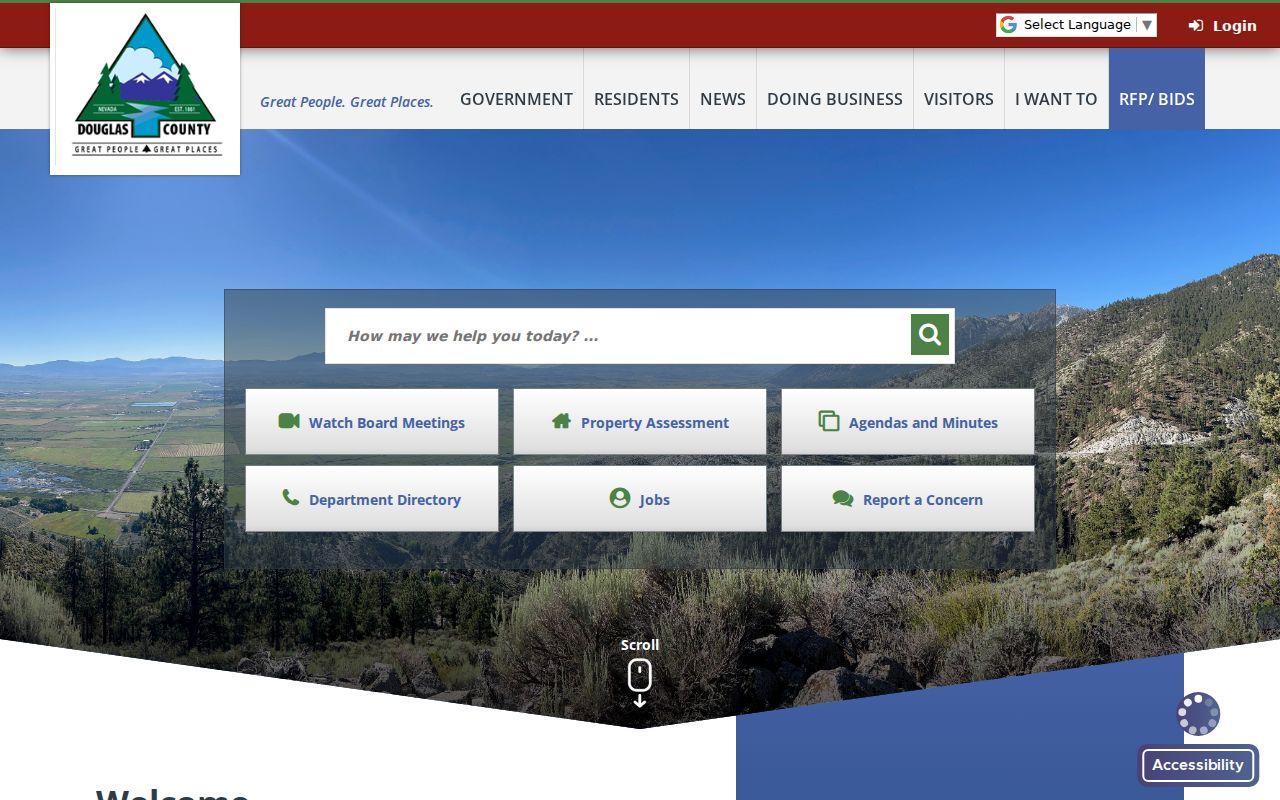
Its department links lead to county records, courts, public requests, and sheriff services rather than city agencies.
Nevada Official Background Checks
RCCD's Central Repository holds fingerprint-supported Nevada arrest cycles and reported dispositions. It does not offer the general public an unrestricted name search of another person. A subject seeking a personal Nevada record completes DPS-006, supplies a rolled ten-print card, and follows the current payment and identification instructions on the Nevada criminal-history request page. The result is Nevada-only and generally covers fingerprint-supported records since 1987.
The request asks for a legal name, aliases, birth details, physical descriptors, contact information, signature, and a complete fingerprint card. RCCD states that processing can take up to 30 calendar days, apart from mailing. DCSO Records advertises fingerprinting at its Minden counter, but a current capture fee was not found in the official material. Confirm the appointment, card, purpose code, and fee before visiting.
The RCCD request screen shows why personal history uses a formal channel.
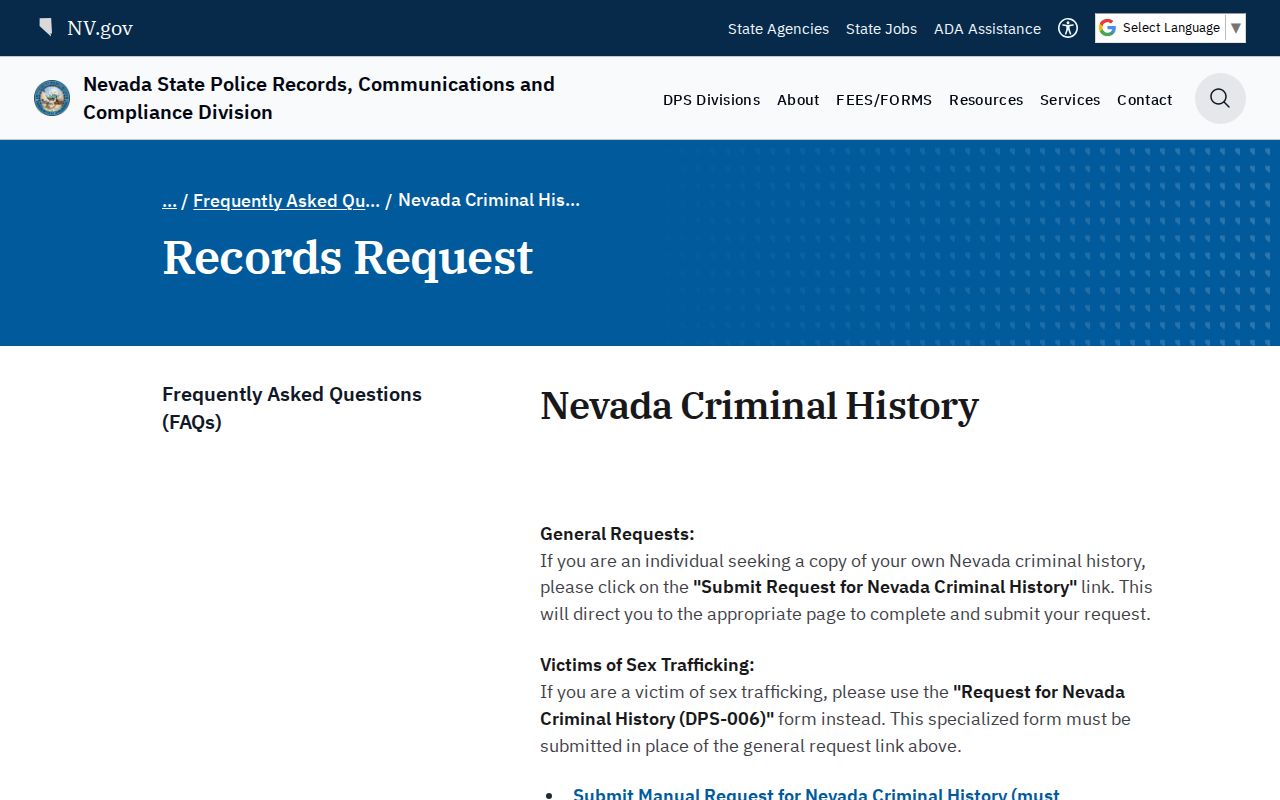
The official form route is distinct from a Douglas County court or jail lookup.
| Official product | Known cost | Scope |
|---|---|---|
| Nevada subject record | Verify current RCCD schedule | Fingerprint based, subject only, Nevada records |
| FBI Identity History Summary | $18 FBI fee | Subject only, national FBI holdings |
| Douglas County court search | Free portal where available | Local case docket; copies and certification may cost |
| DCSO fingerprint capture | Confirm with Records | Print service, not a history report |
Douglas County Records Meet at JLEC
The Judicial and Law Enforcement Center, or JLEC, concentrates much of the Douglas County record path at 1038 Buckeye Road in Minden. The first floor holds sheriff operations and the county jail. The second floor houses District Court rooms, East Fork Justice Court, court clerks, the District Attorney, Juvenile Probation, and other justice offices. One building can therefore create or hold the report, booking entry, early court case, later felony file, and supervision order without merging them into one record.
DCSO Records operates a Valley counter there at 775-782-9933, Monday through Friday from 8 a.m. to 5 p.m. A Lake counter operates at 175 U.S. Highway 50 in Stateline at 775-586-7260 during the same posted hours. Jail Administration at 775-782-9944 handles current booking and bail verification.
The county's JLEC history and agency page provides a view of the operating center.
That shared site explains why office ownership, not the street address alone, controls each request.
DCSO Records, Valley
1038 Buckeye Road
Minden, NV 89423
775-782-9933
Weekdays, 8 a.m.-5 p.m.
Tenth Judicial District Court
1038 Buckeye Road
Minden, NV 89423
775-782-9820
Criminal case files and certified copies
DCSO Records, Lake
175 U.S. Highway 50
Stateline, NV 89449
775-586-7260
Weekdays, 8 a.m.-5 p.m.
Criminal Record Types
Douglas County criminal records describe different stages of the justice process. An incident report records allegations, officer observations, and evidence references. A booking entry records jail intake and current holds. A complaint, information, or indictment states the charge filed in court. The clerk's file then tracks hearings, motions, pleas, judgment, sentence, and financial entries. RCCD compiles fingerprint-linked Nevada arrest cycles with the dispositions agencies report.
Warrants, supervision data, custody status, and registry entries also have separate custodians. DCSO and a court can confirm local warrant information. Douglas County Alternative Sentencing supervises qualifying pretrial and misdemeanor cases, while Nevada Parole and Probation handles felony probation and parole. NDOC covers sentenced state custody. The Nevada Sex Offender Registry publishes the public-notification subset required by law.
Nevada classifies felonies from category A through category E. Category A penalties are offense-specific and can include life terms. Category B terms generally range from at least one year to no more than 20 years, while categories C, D, and E use shorter baselines in NRS 193.130. A gross misdemeanor can bring up to 364 days in county jail and a misdemeanor generally up to six months, unless a specific law changes the penalty. The charge statute, not the label alone, controls. Felonies proceed to the Tenth Judicial District Court after the justice-court stage; ordinary misdemeanors remain with East Fork or Tahoe Justice Court.
- Disposition
- The court's outcome for a charge or case.
- Bind over
- The transfer of a felony matter from justice court to District Court.
- Repository record
- A person-based Nevada compilation tied to fingerprints and reported outcomes.
- Record sealing
- A court-ordered restriction that removes qualifying records from general access without destroying them.
Douglas County Records Tell Different Stories
A booking app, court portal, and repository report answer different questions. The DCSO app is best for present or recent county custody and changing bail information. A court docket is best for the charge the prosecutor filed, the hearings held, and the disposition entered. An RCCD history is best for a subject's fingerprint-linked Nevada arrest cycles and reported results.
| Record | Best use | Key limit |
|---|---|---|
| DCSO booking record | Intake, custody, bail, release | Does not prove guilt or show the final charge |
| Court case file | Filed counts, hearings, orders, outcome | Not a statewide identity history |
| RCCD subject history | Fingerprint-linked Nevada cycles | Can miss old, unreported, federal, or out-of-state events |
DCSO confirms that its mobile app is the current online route for inmate and bail data because the public web inmate list is marked as coming soon. The official “Douglas County Sheriff” app is available through Apple and Google Play. Bail can change, so verify it with Jail Administration before acting.
The DCSO homepage identifies the county's main local record agency.
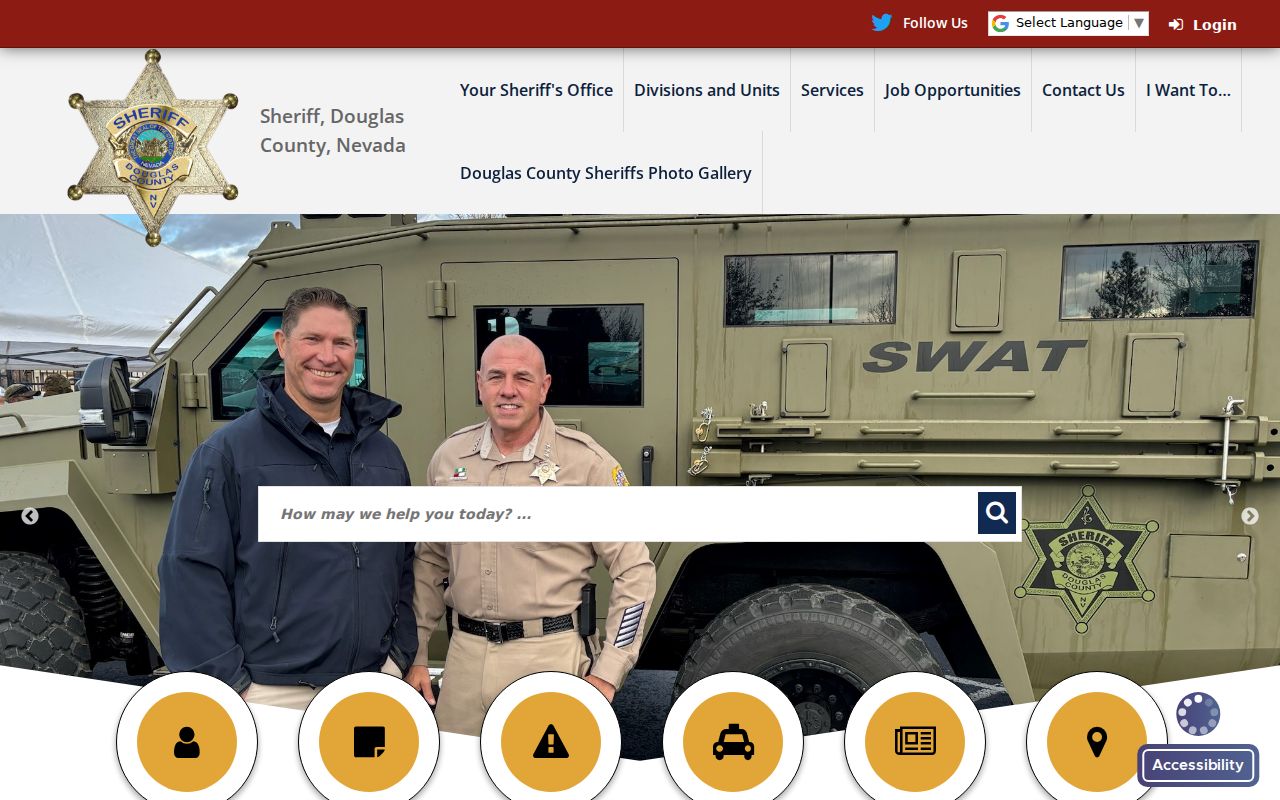
Its divisions separate patrol reports, Records services, jail data, and local registration work.
Inside a Douglas County Criminal Record
The fields depend on the source. A Nevada repository record starts with identity and fingerprint identifiers, then lists an arrest date, agency, tracking data, charges, and any prosecutor or court disposition that was reported. A Douglas County court file adds the case number, court and division, filing date, charge statute and level, lawyers, docket events, scheduled hearings, result, sentence, balances, and warrant or bond flags. Jail data adds booking time, current custody, bail, and release status.
| Name and identifiers | Legal name, aliases, birth details, physical descriptors, and person-based state identifiers where lawfully shown. |
|---|---|
| Arrest and booking | Agency, date, booking number, intake charge, fingerprint transaction, hold, bail, and release data. |
| Filed charges | Complaint, information, or indictment counts with statute and offense level. |
| Case events | Arraignment, motions, hearings, plea or trial, and register-of-actions entries. |
| Outcome | Dismissal, acquittal, conviction, sentence, restitution, fines, or supervision terms. |
| Restrictions | Sealed cases, juvenile files, victim data, and private identifiers are withheld or redacted. |
A name match alone does not establish identity. Compare the court, case number, dates, and lawful identifiers, then obtain the record from its custodian.
Douglas County Records Requests
The routine route is often fastest. Ask DCSO Records for a sheriff incident or collision report, and ask the right clerk for a court file. When no routine form fits, the county's Nevada Public Records Law request page provides the county form. Save the PDF before filling it, describe an identifiable existing record, and submit it by the listed email or by mail to P.O. Box 218, Minden, NV 89423.
The custodian must provide the record or a permitted response by the end of the fifth business day under NRS 239.0107. That is a response rule, not a promise of full production. An office need not answer broad questions or create a new compilation. Research and copying beyond 30 minutes can bring an extraordinary-use charge quoted before production.
The county request page shows the formal fallback when a normal counter request is not enough.
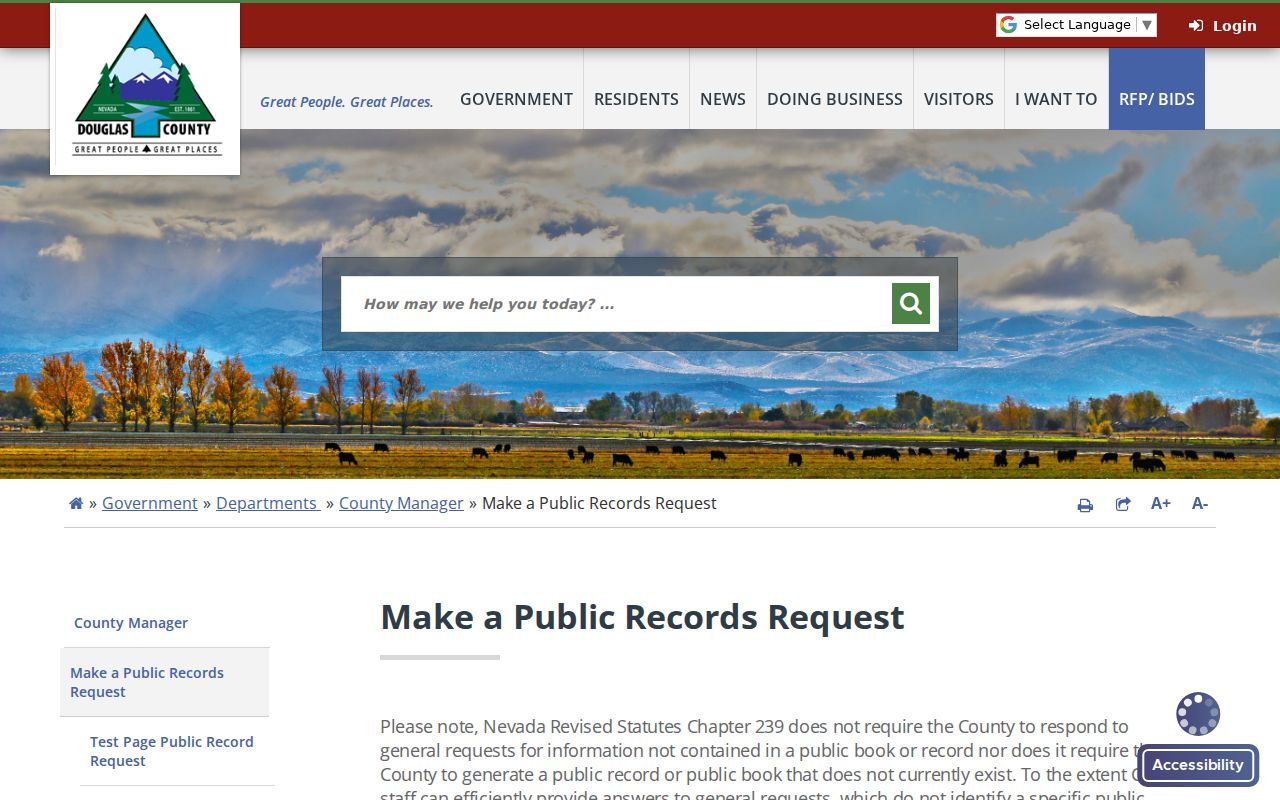
Specific dates, departments, report numbers, and delivery preferences help the custodian find the record.
| DCSO item | Posted price |
|---|---|
| Accident report | $1, free by email |
| Criminal report | $1, free by email |
| Name search | $1, free by email |
| Good-guy letter | $10 |
| Subpoena | $30 |
| Body-camera request | Free request; production limits may apply |
Public Access Laws in Nevada
Public access depends on the record and its custodian. Nevada Public Records Law opens government records unless another law makes them confidential. NRS Chapter 179A controls criminal-history dissemination and gives a subject access and challenge rights for RCCD data. Court records follow judicial access and redaction rules. Sealed cases, confidential juvenile matters, protected victim details, personal identifiers, and some investigative material remain outside general public access.
Key Nevada laws:
NRS 239.010 and 239.0107 open nonconfidential government records and set the five-business-day response duty.
NRS 179A.100 governs dissemination and a subject's fingerprint-linked Nevada history request.
NRS 179A.150 provides inspection and challenge rights for repository data.
NRS 179.245 and 179.255 govern qualifying conviction and nonconviction sealing routes.
NRS 179B.250-.300 governs public registry access and protects victim identity.
Ask for the narrow record actually needed. A sheriff report, court case, personal repository copy, corrections entry, and registry result remain separate public-access questions.
Douglas County Custody Systems Compared
The Douglas County Jail holds local pretrial detainees and some people serving county terms. The DCSO app and Jail Administration are the current verification channels. The NDOC Offender Search covers sentenced Nevada offenders and can show an NDOC identifier, institution or status, and sentence or parole data. It does not replace the county booking source. The federal Bureau of Prisons locator is a third system for federal custody.
The NDOC search screen makes its state-custody scope clear.
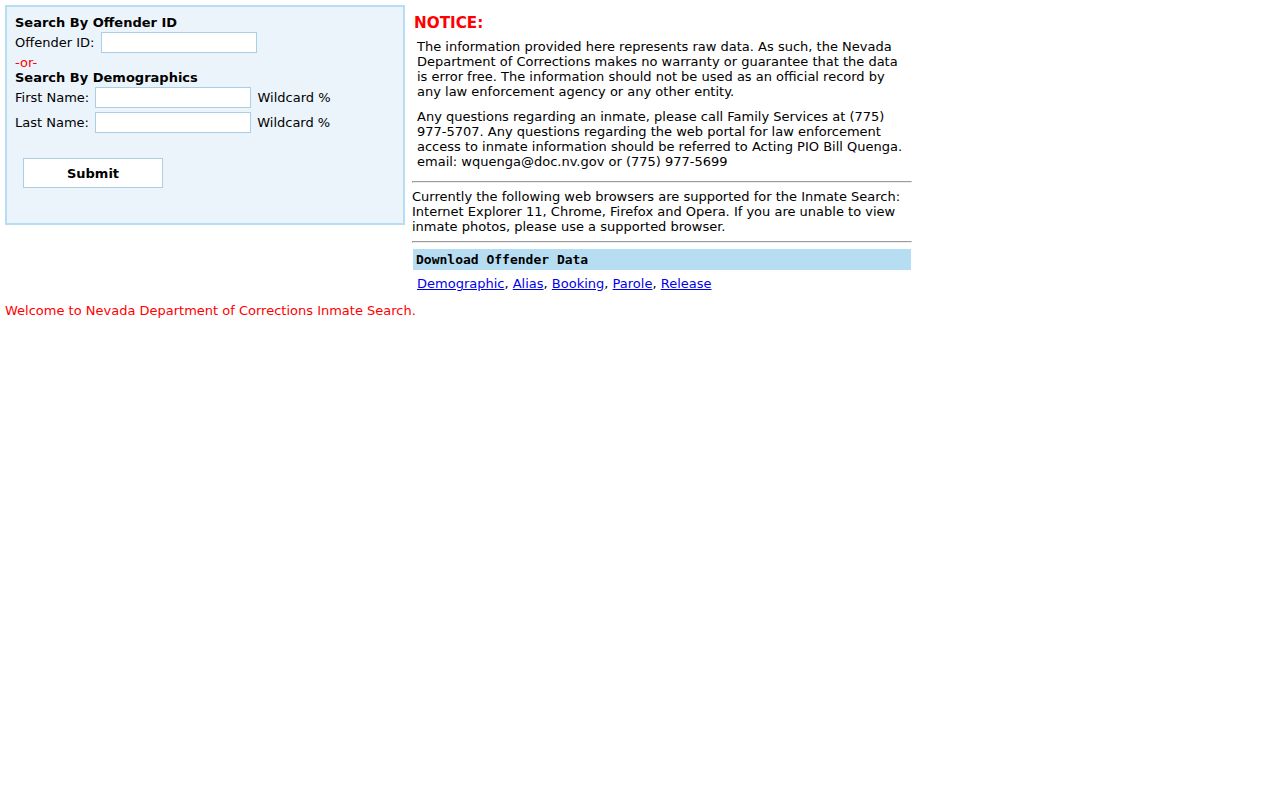
Use the custody authority, not a broad name search, to decide which locator applies.
Supervision splits as well. Douglas County Alternative Sentencing oversees pretrial, pre-sentence, and misdemeanor programs. Nevada's Division of Parole and Probation supervises felony probationers and parolees, while the Board of Parole Commissioners makes release decisions. The public court docket can show a sentence, revocation filing, warrant, and result, but confidential officer notes and treatment data are not the same as an open case file.
The Nevada parole authority publishes its own process and decision resources.
That state layer belongs after the court sentence, not in the county jail search.
Sealed, Expunged, and Restricted Records
Nevada uses record sealing rather than destruction. NRS 179.245 sets waiting periods for qualifying convictions, measured from release, discharge from supervision, or the latest conviction as the statute directs. NRS 179.255 covers many dismissals, acquittals, and declined prosecutions. Some sexual offenses, crimes against children, and other listed offenses cannot be sealed. Current statutory text controls eligibility and timing.
Douglas County court jurisdiction matters. A person needs complete identifiers for each justice and district case, obtains certified dispositions and a personal Nevada history as required, then files in the court that handled the matter. The local DCSO checklist contains older dollar figures, so confirm all current costs. RCCD estimates the total process may take about two to four months when order data is accurate.
The state Nevada record-sealing page explains what the order changes and who may still have authorized access.
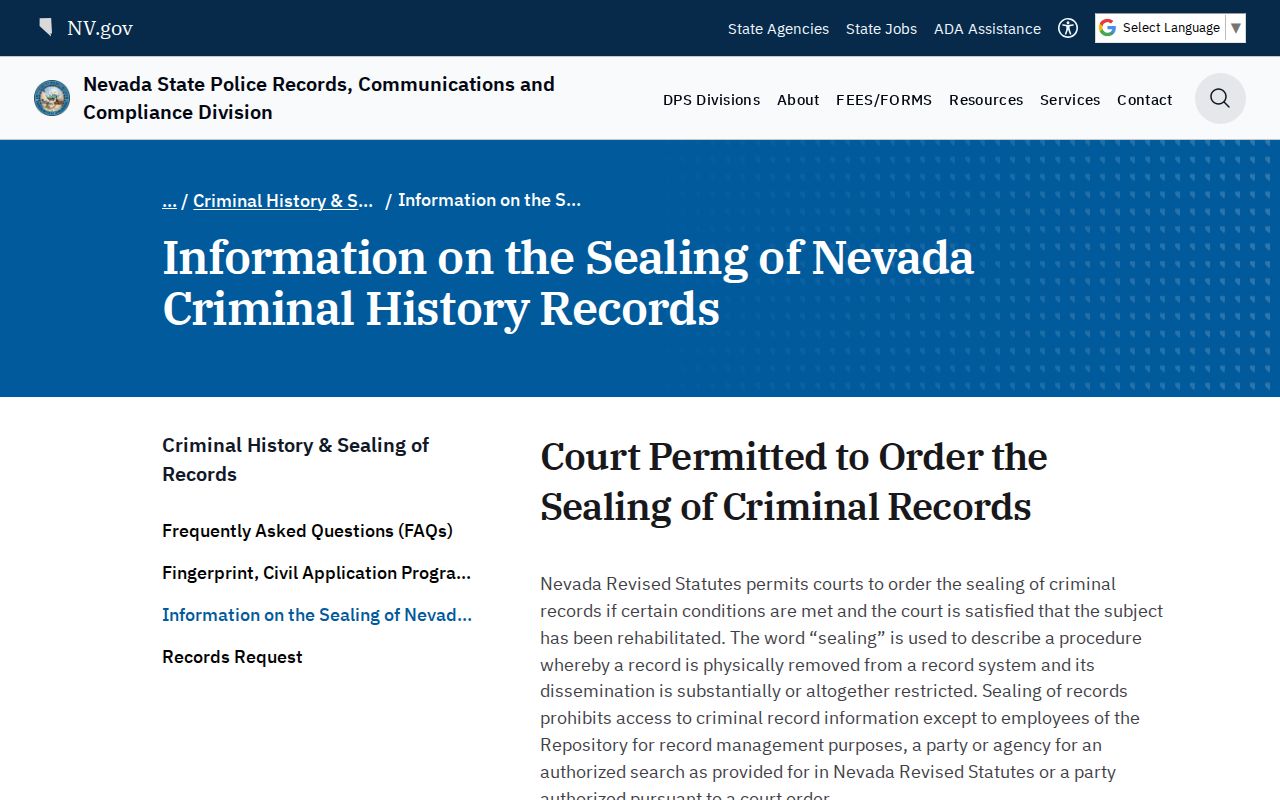
A sealed record leaves general information sources but can remain available for repository management and uses authorized by law.
Douglas County Warrants Need Two Checks
No comprehensive official DCSO public warrant database was found. Start with DCSO at 775-782-9900 and the clerk for the court that may have issued the warrant. A case docket can show a bench-warrant event, but a sealed or very recent warrant may not appear. For immediate custody or bail status after an arrest, call Jail Administration at 775-782-9944.
Resolution is court-specific. Identify the issuing court and case, ask whether bail or an appearance is required, follow the clerk or court's instruction, and obtain written proof after the issue is cleared. Do not assume that walking into a law-enforcement lobby guarantees release. The DCSO Secret Witness number receives crime information; it is not a personal warrant-clearance service.
Note: An empty web search cannot establish that no Douglas County warrant exists; confirm with the issuing court and DCSO.
Douglas County Criminal Records by City
There are no incorporated cities in Douglas County, so no city criminal-record pages are deployed. Nevada's official incorporated-city list contains no Douglas County municipality, and the county identifies Gardnerville, Genoa, and Minden as unincorporated towns. DCSO supplies local policing, East Fork and Tahoe Justice Courts supply township-level dockets, and the Tenth Judicial District Court supplies the felony trial file. Calling these communities cities would point readers to police departments and municipal courts that do not exist.
Douglas County Justice Records Are Changing
The operating JLEC dates to about 1980 or 1982, depending on the county source cited. It was planned when Douglas County had about 19,000 residents, and the jail expanded in 2011. County reports now describe crowded courtrooms, narrow clerk areas, too little private attorney-client space, access concerns, and poor separation among court users. Those facts led to a new Buckeye Road Justice Center design effort.
The planned center is intended for courts and the District Attorney. Until the county posts an official opening and counter-move notice, records requests should still use the operating addresses and phone lines. A new building rendering does not prove that a clerk has moved. In a separate access change, all three Douglas County courts launched a new jury case-management system in 2024 and warned that real summonses arrive by mail, not through demands for instant payment.
The justice system has also grown. Nevada Judiciary's FY2025 report lists 368 District Court criminal filings, 1,040 East Fork criminal filings, and 532 Tahoe criminal filings. Those are filings, not people or convictions. They show why choosing the correct Douglas County court is a key search step.